
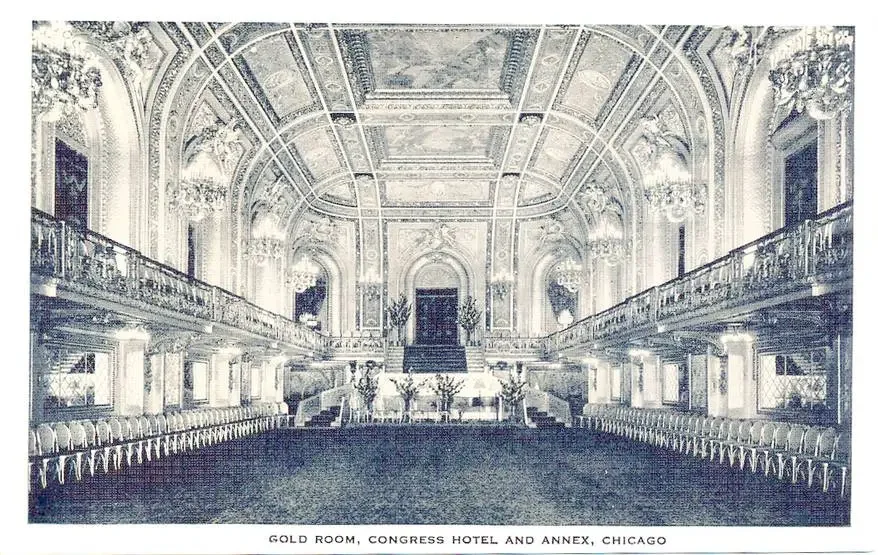
A recently conserved painting by Edward J. Holslag (American, 1870–1935) offered a vivid glimpse Chicago at the height of its Gilded Age -- when grand hotels dazzled visitors, decorative painting filled expansive interiors, and artists were called upon to match the city’s architectural ambition stroke for stroke.
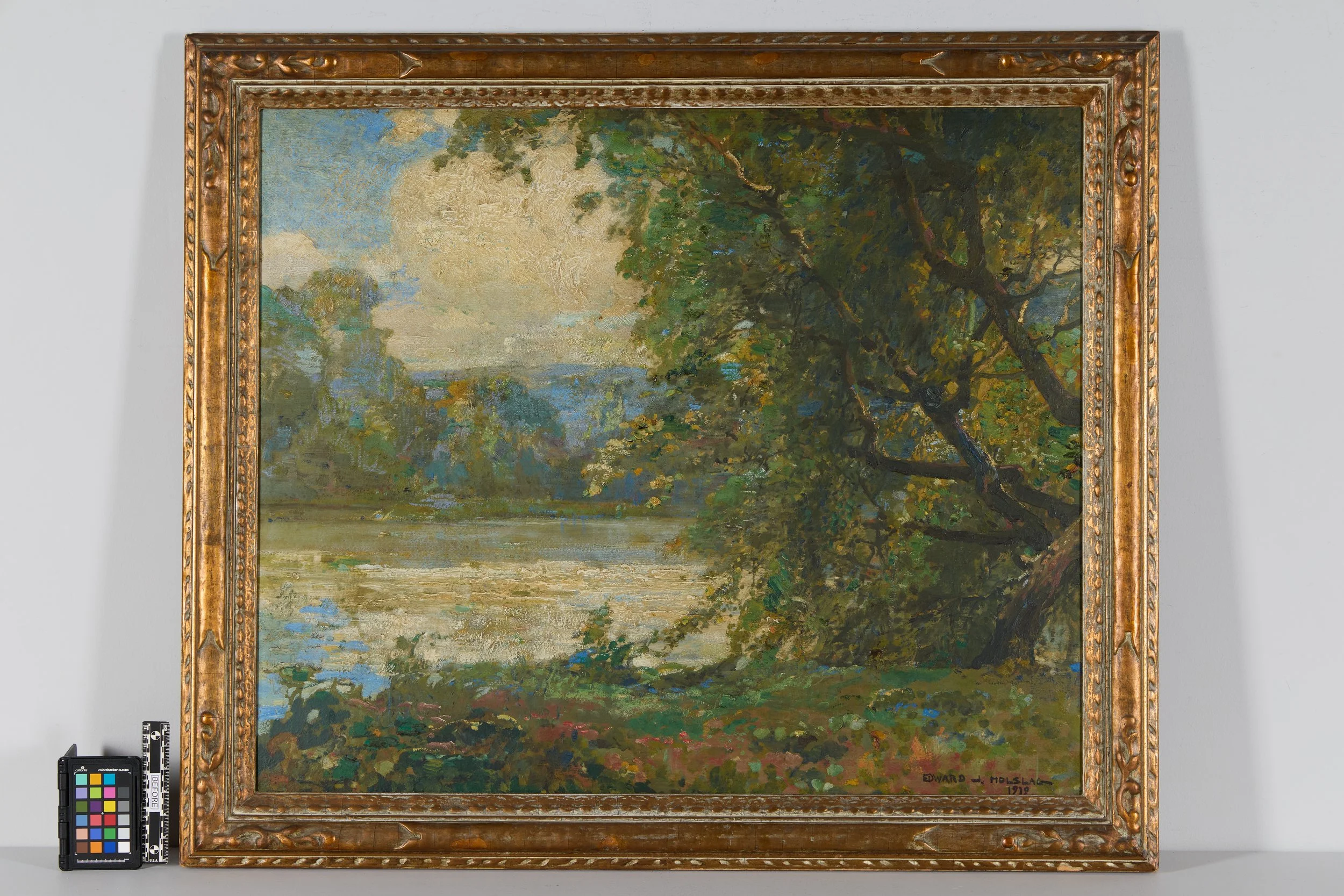
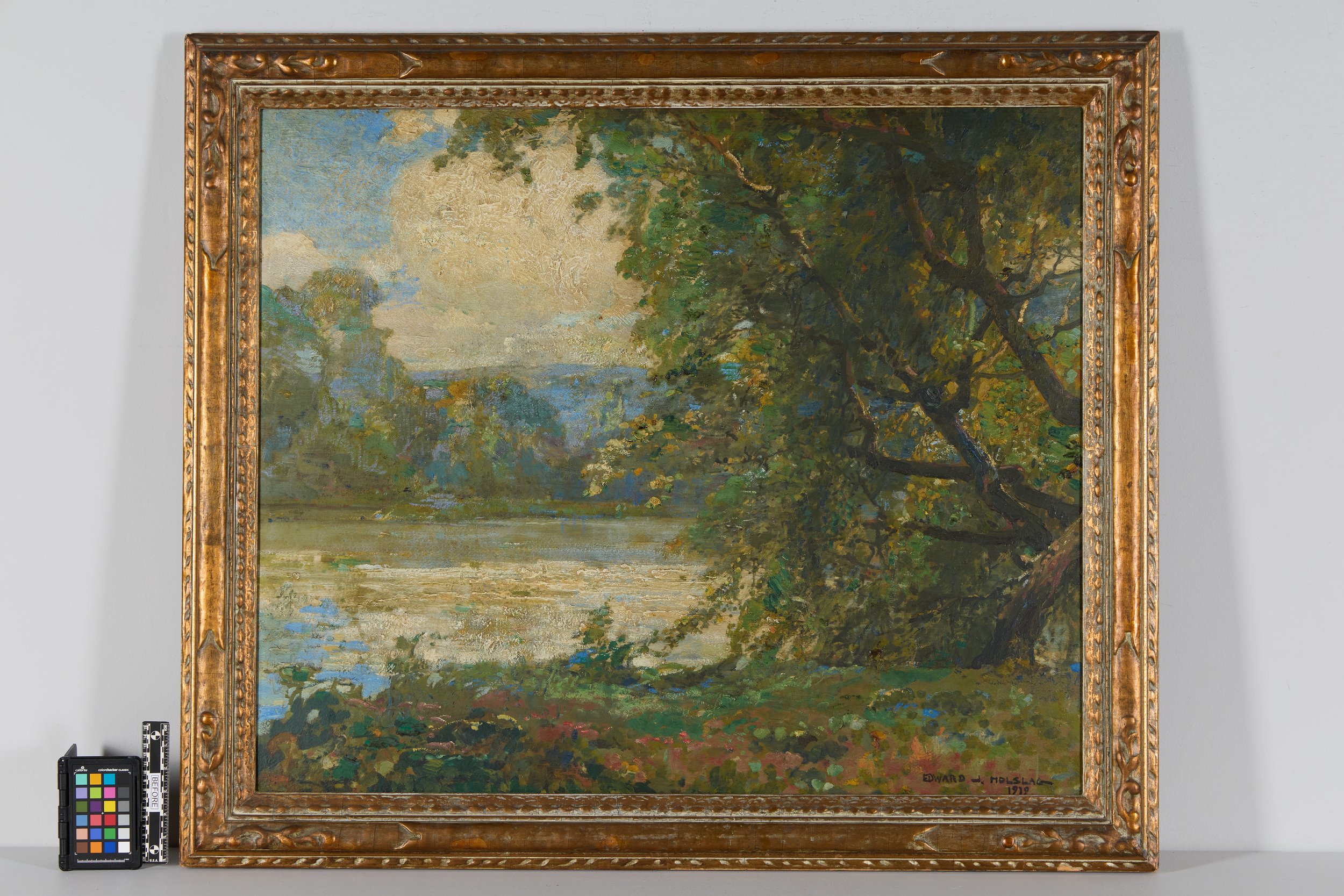
Before treatment.
Watch Rebecca Vodehnal, associate paintings conservator, treat the painting below — then scroll down to learn more about the artist and process.
Holslag combined rigorous academic training with broad international influence. Born in Buffalo, New York, he studied at the National Academy of Design under John LaFarge before continuing his education in Europe. There, he absorbed the stylistic language that would shape American mural painting at the turn of the twentieth century. Early in his career, Holslag contributed to mural projects at the Library of Congress in Washington, D.C., before establishing a prolific practice focused on large-scale decorative programs for banks, hotels, and public buildings across the United States.
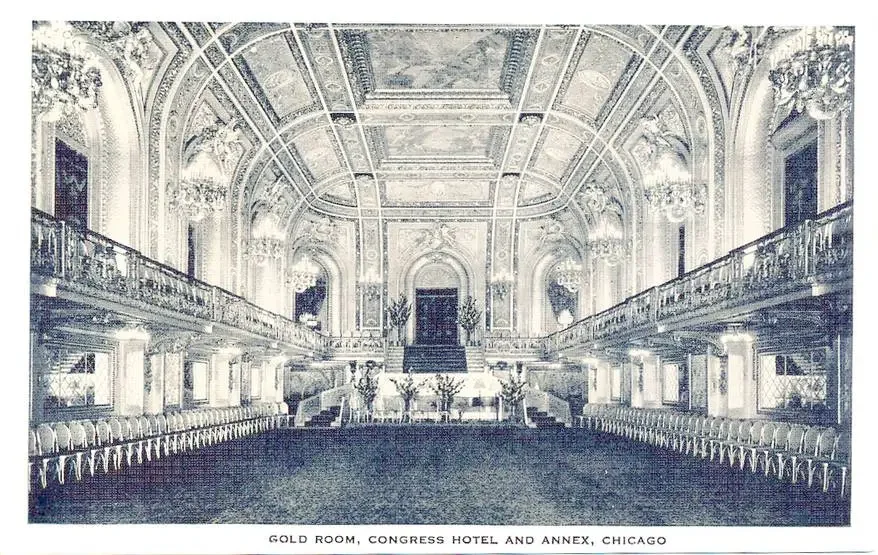
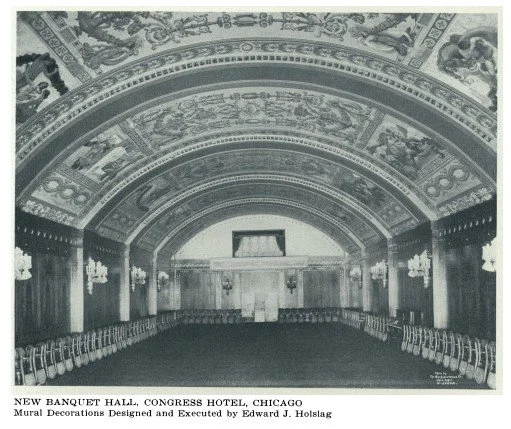
One of his most ambitious commissions was in Chicago at the Congress Plaza Hotel. Originally constructed in 1893 during the city’s expansion surrounding the World’s Columbian Exposition, the hotel was designed by architect Clinton J. Warren as a Beaux-Arts showpiece. Holslag’s decorative painting program within the building was remarkable for its scope: contemporary accounts describe nearly two and a half miles of painted passages extending through eleven corridors, placing the project among the most extensive campaigns of its time.
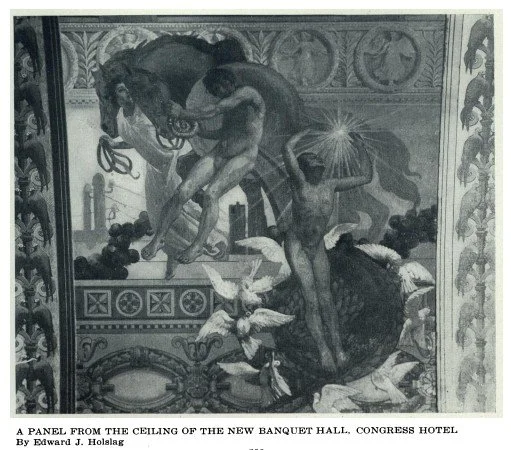
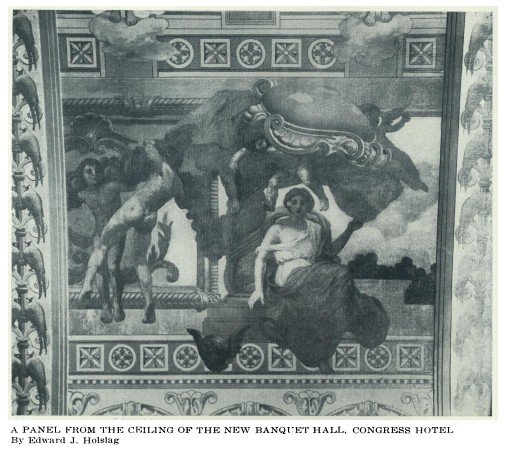
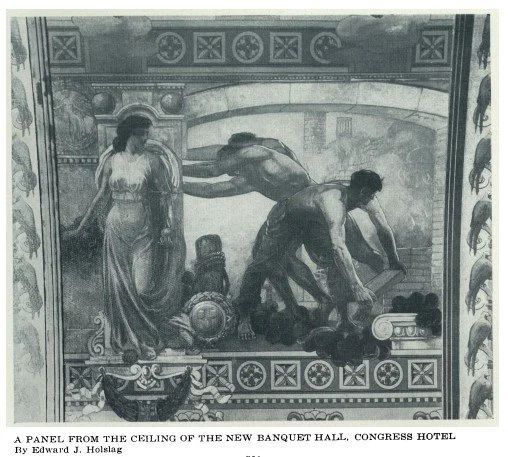
This Holslag landscape arrived at The Center still housed in its original frame. Executed on a composition board support, the work exhibited numerical inscriptions on the reverse and showed clear evidence of age and past handling. The edges of the board were frayed, the corners rounded, and areas of ply delamination were present. The reverse exhibited paint splatters, accumulated grime, dark staining, and gouges.
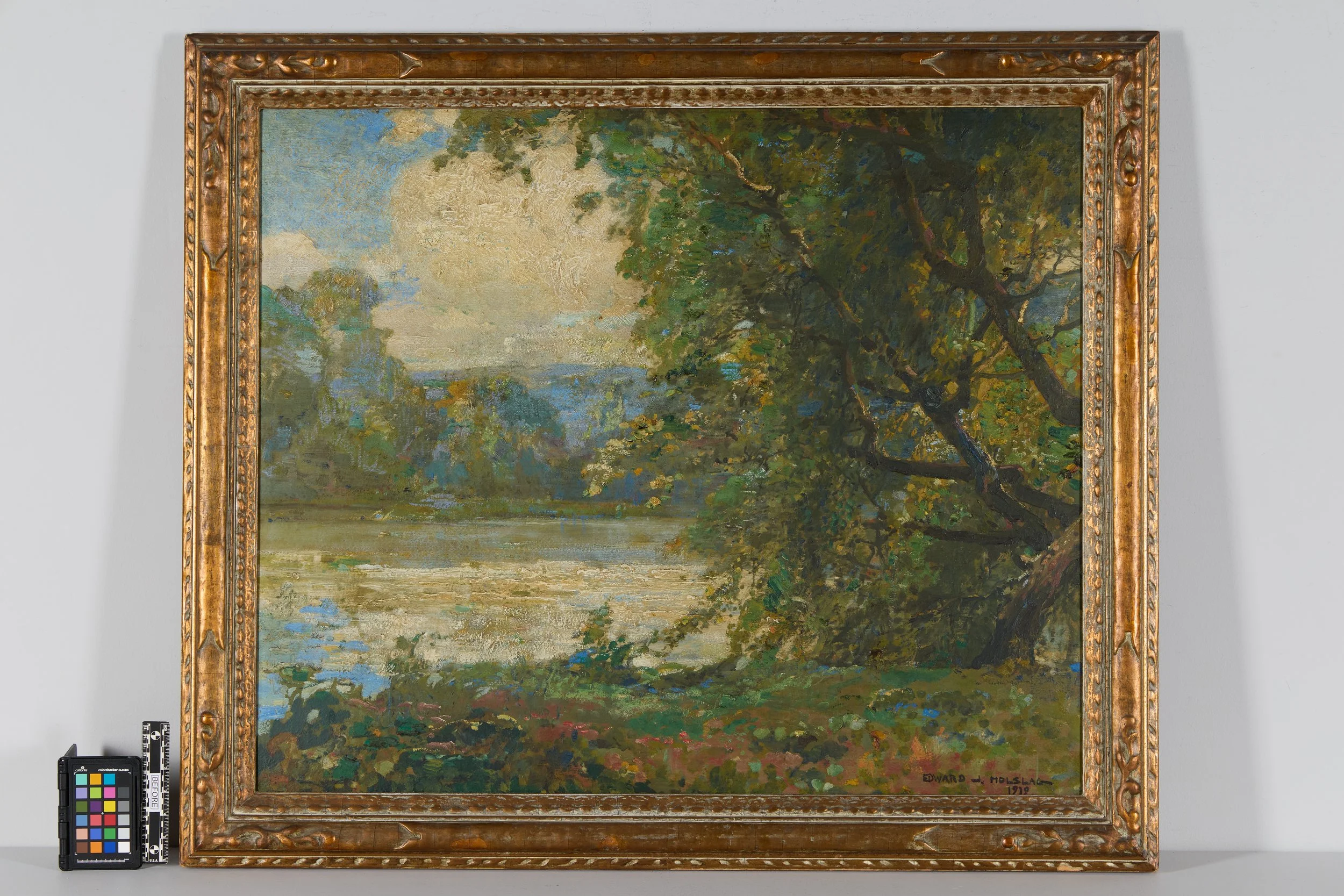
Before treatment.
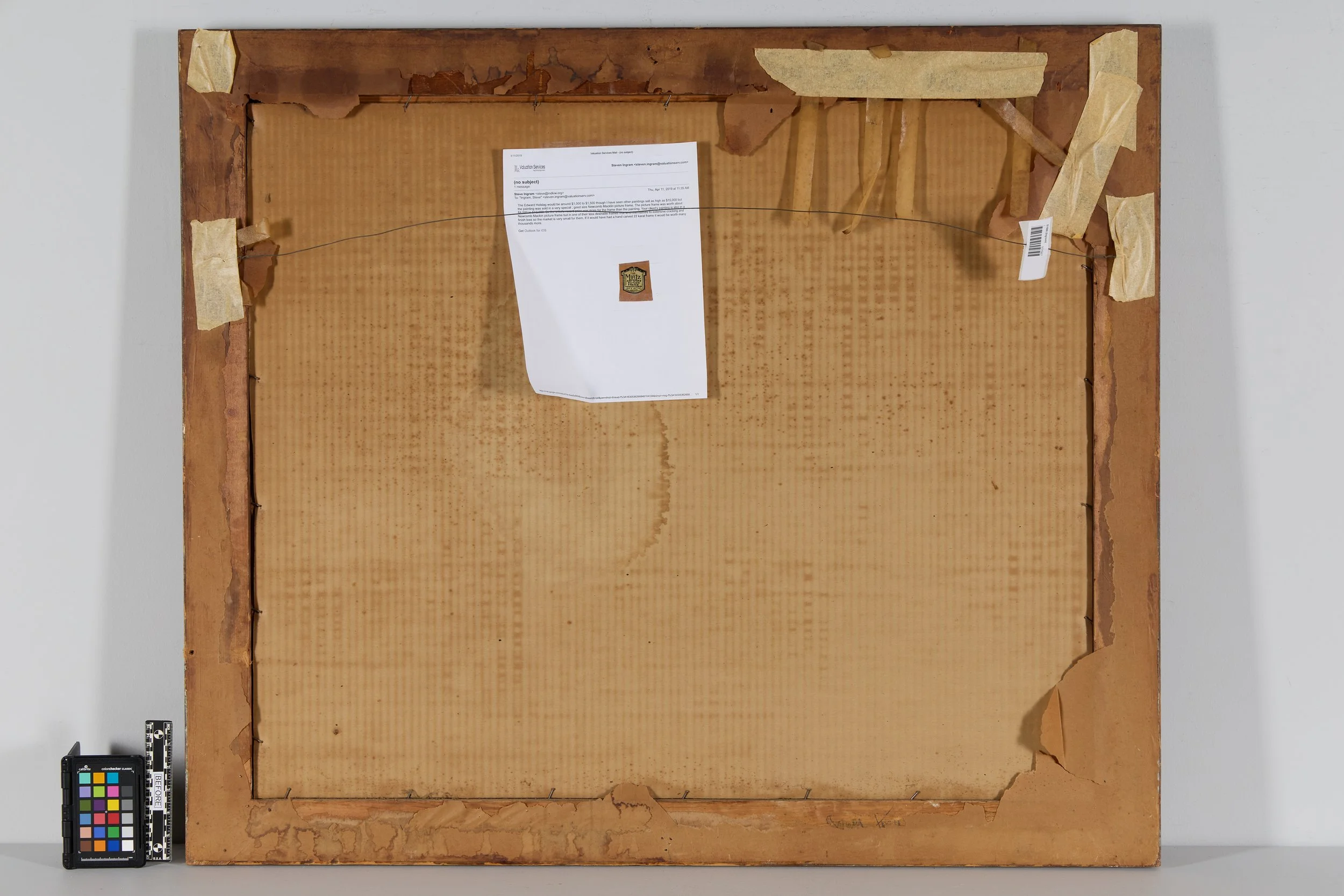
Verso before treatment.
On the painted surface, a white ground layer supported moderately to thickly applied oil paint. The image was obscured by an uneven, discolored natural resin varnish and a layer of surface grime. Frame abrasions were visible along all four edges, with small paint losses scattered over the surface. The painting was signed in the lower right corner, “Edward J. Holslag / 1919.”
Treatment was fully documented with photography taken before, during, and after conservation. Structural stabilization began with consolidation of the frayed edges and securing areas of delamination to restore the board’s overall integrity. Surface cleaning reduced accumulated grime using dry methods and carefully controlled aqueous solutions, while the reverse was gently cleaned with a soft brush and low-suction vacuum.
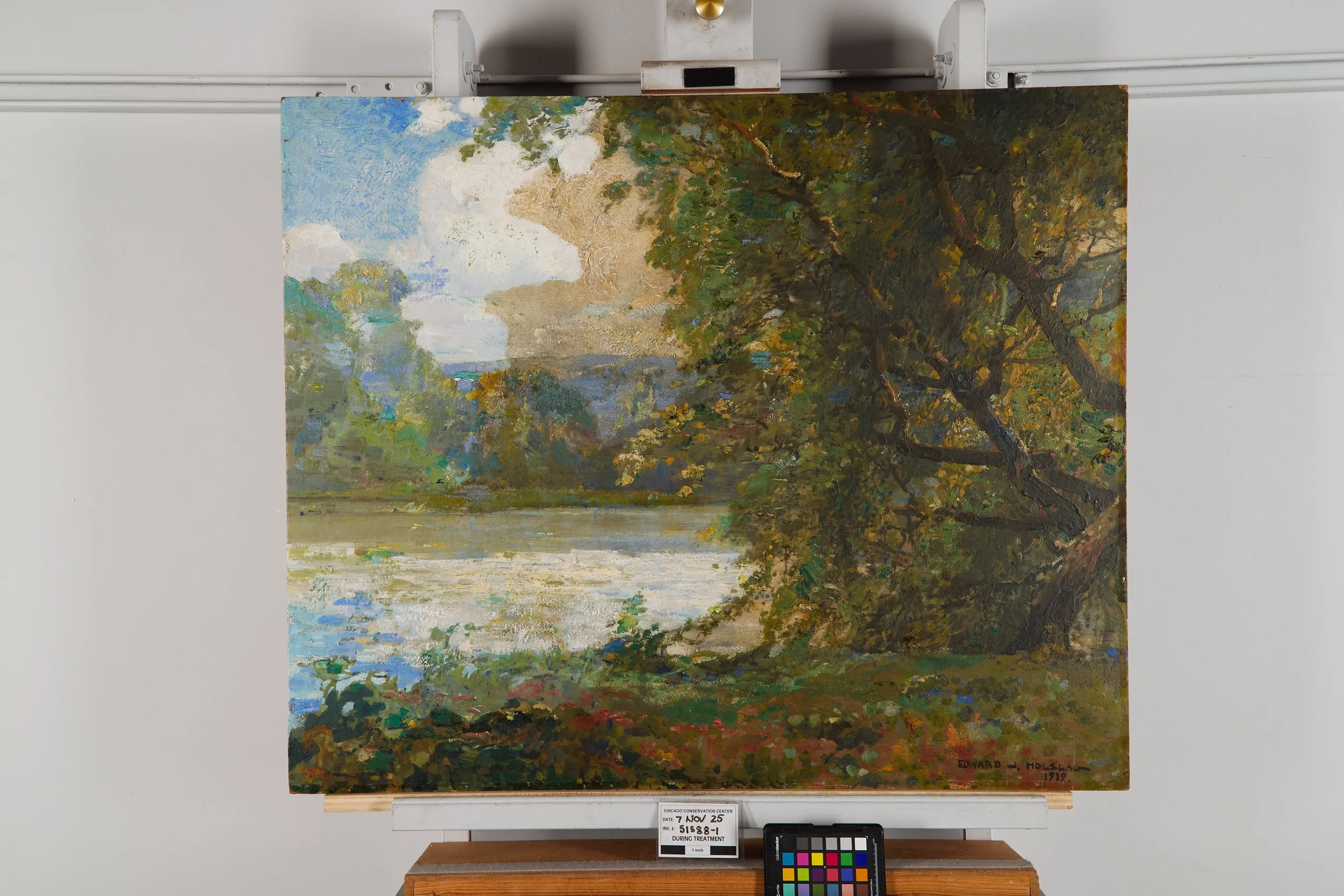
During treatment.
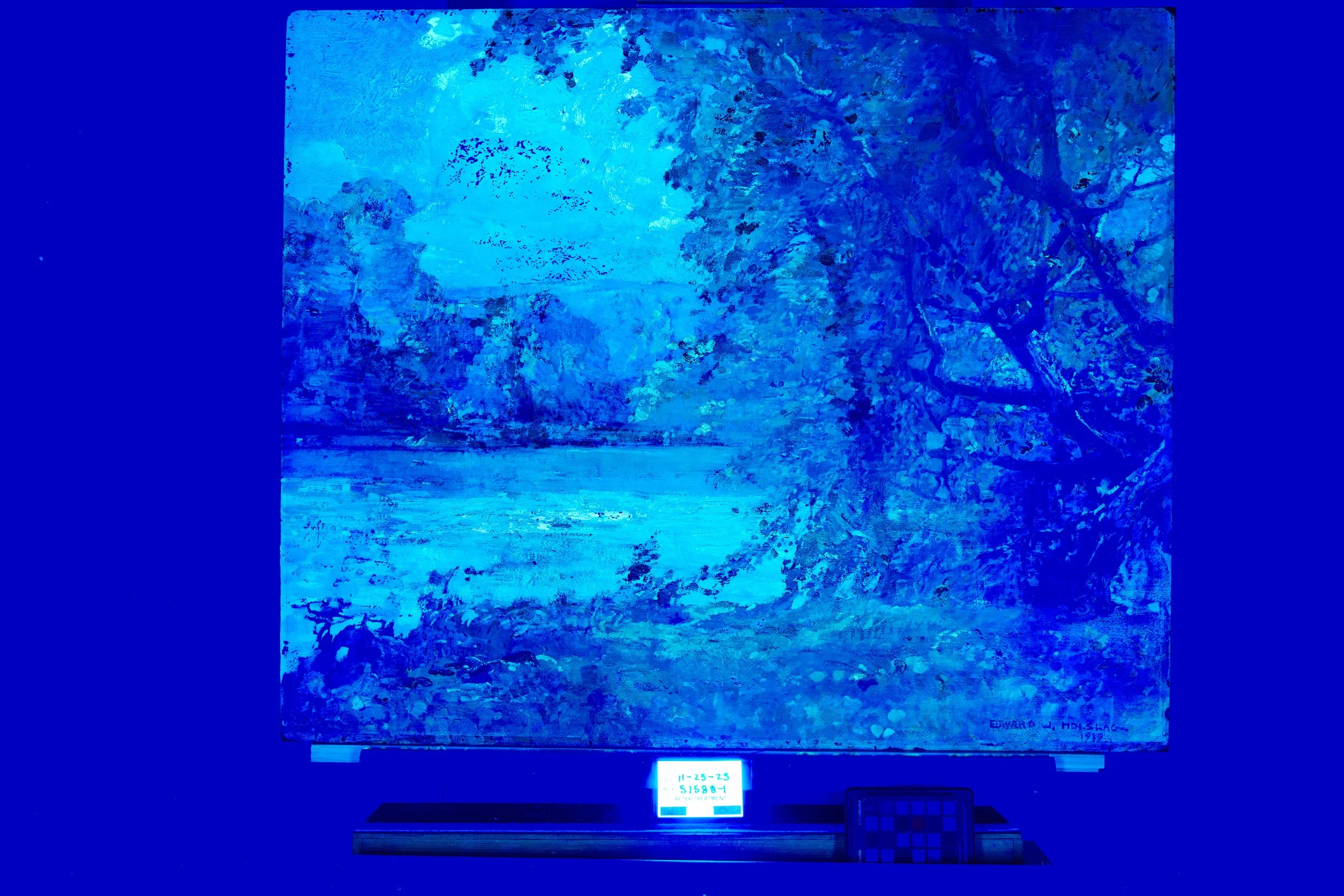
Under UV light during treatment.
The discolored varnish was then reduced using selected solvents, improving clarity and revealing the depth and nuance of Holslag’s original palette. Areas of paint loss and abrasion were inpainted with reversible conservation materials, followed by the application of a new varnish to saturate the paint layer. A final varnish layer unified surface gloss and enhanced visual cohesion.
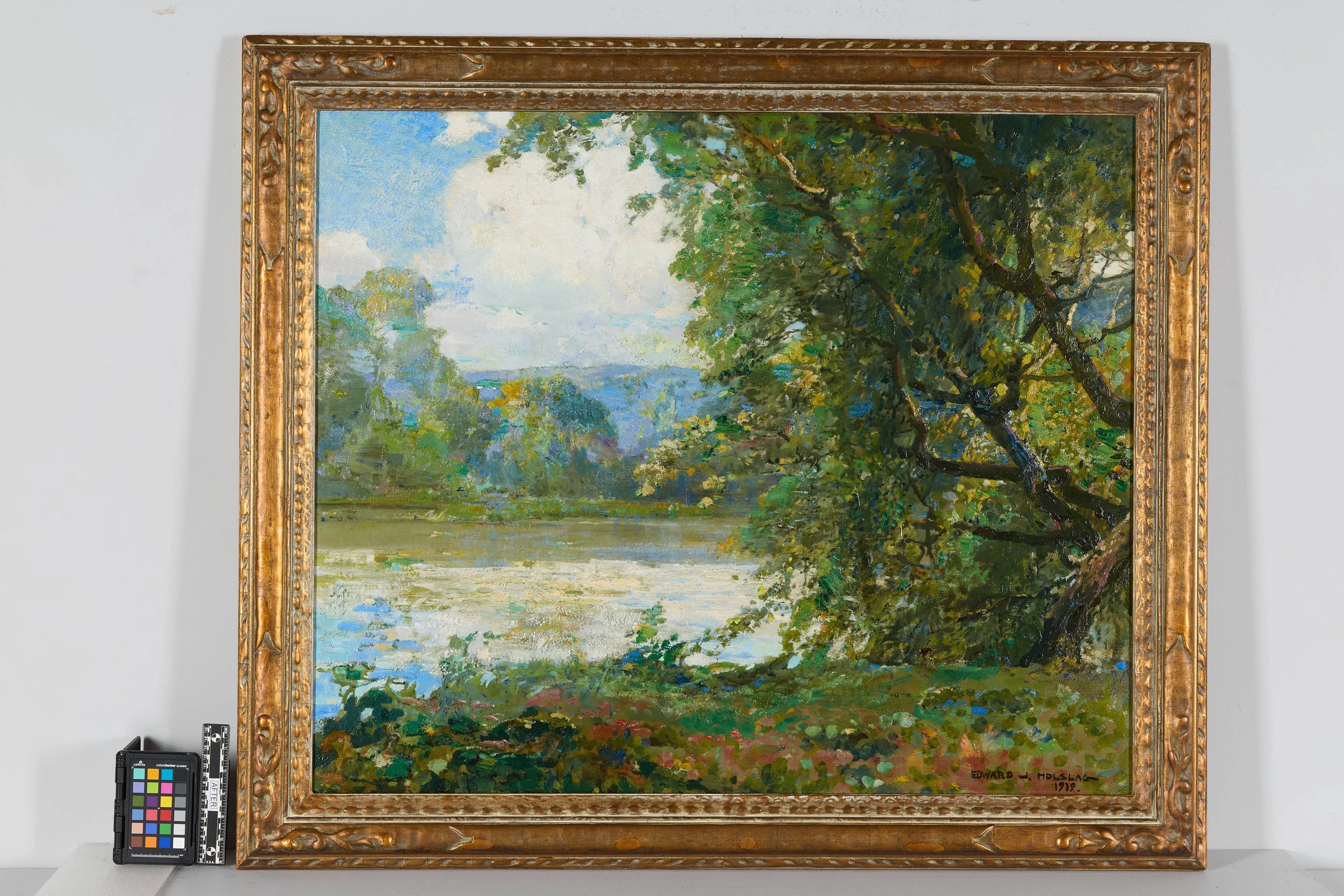
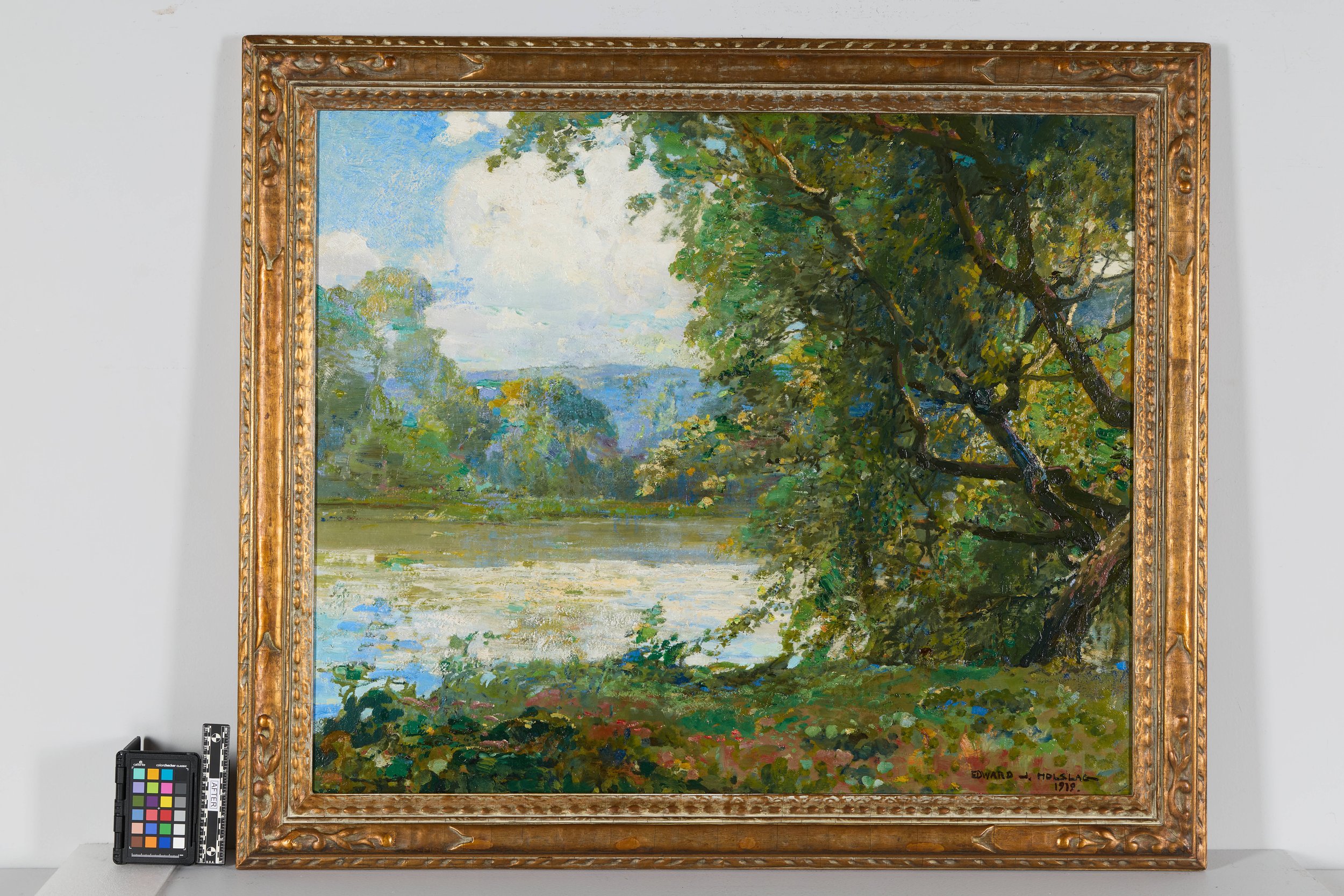
After treatment.
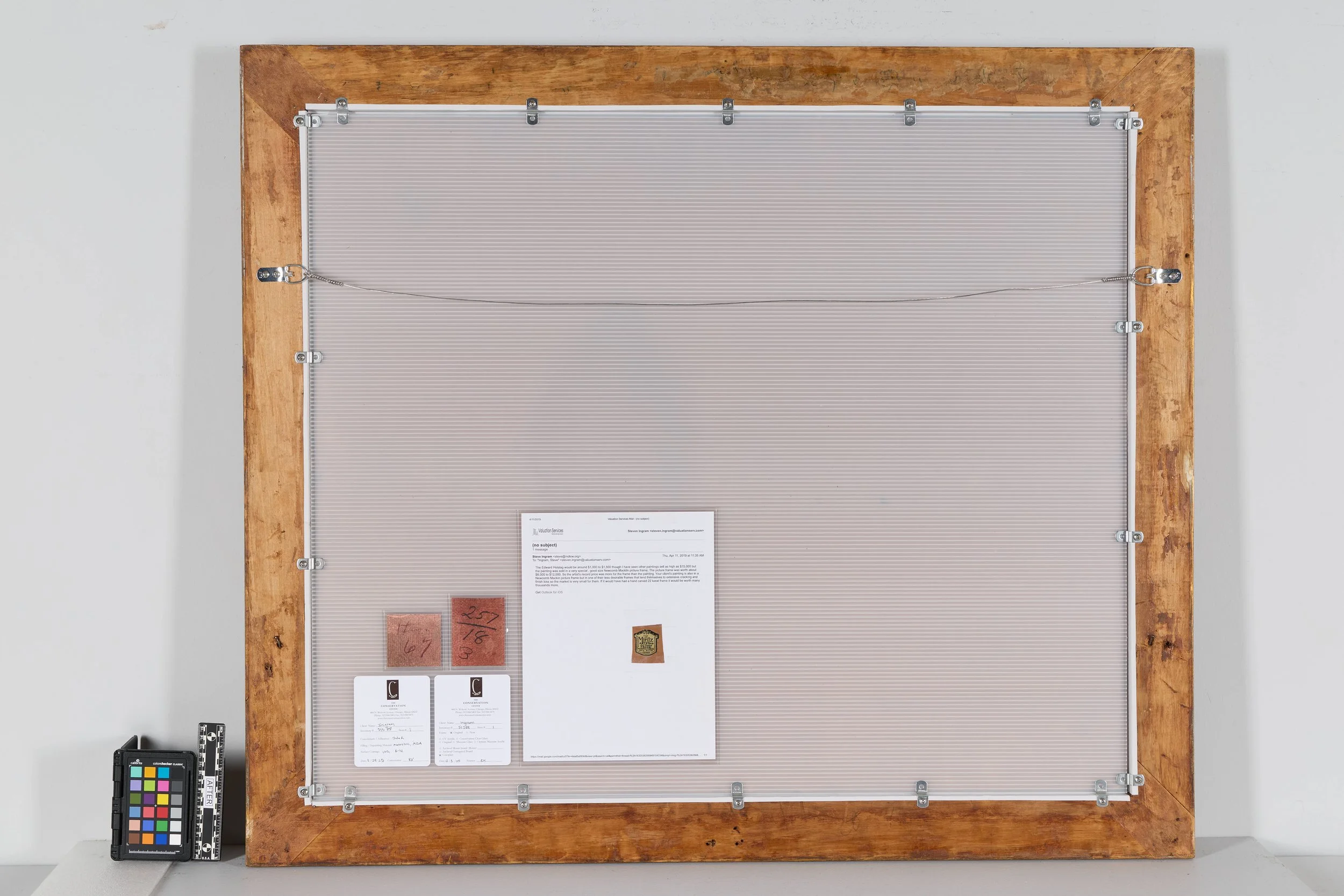
Verso after treatment,
At the conclusion of treatment, the painting’s surface was stable and its visual impact restored. Holslag’s confident handling of paint and decorative sensibility could once again be fully appreciated. The project renewed a tangible connection to Chicago’s Gilded Age and reaffirmed the legacy of an artist whose work helped shape the city’s historic interiors.
Sources:
https://www.askart.com/artist/Edward_Joseph_Holslag/66599/Edward_Joseph_Holslag.aspx
https://www.ripleyauctions.com/auction-lot/edward-joseph-holslag-illinois-california-1870_36e438e901
https://www.loc.gov/item/2007680190/
