“When an artist uses a conceptual form of art, it means that all of the planning and decisions are made beforehand and the execution is a perfunctory affair. The idea becomes a machine that makes the art. This kind of art is not theoretical or illustrative of theories; it is intuitive, it is involved with all types of mental processes and it is purposeless. It is usually free from the dependence on the skill of the artist as a craftsman. It is the objective of the artist who is concerned with conceptual art to make his work mentally interesting to the spectator, and therefore usually he would want it to become emotionally dry. There is no reason to suppose however, that the conceptual artist is out to bore the viewer. It is only the expectation of an emotional kick, to which one conditioned to expressionist art is accustomed, that would deter the viewer from perceiving this art.”
— Sol LeWitt, Paragraphs on Conceptual Art, Artforum, Summer 1967, Vol. 5, No. 10, p. 80
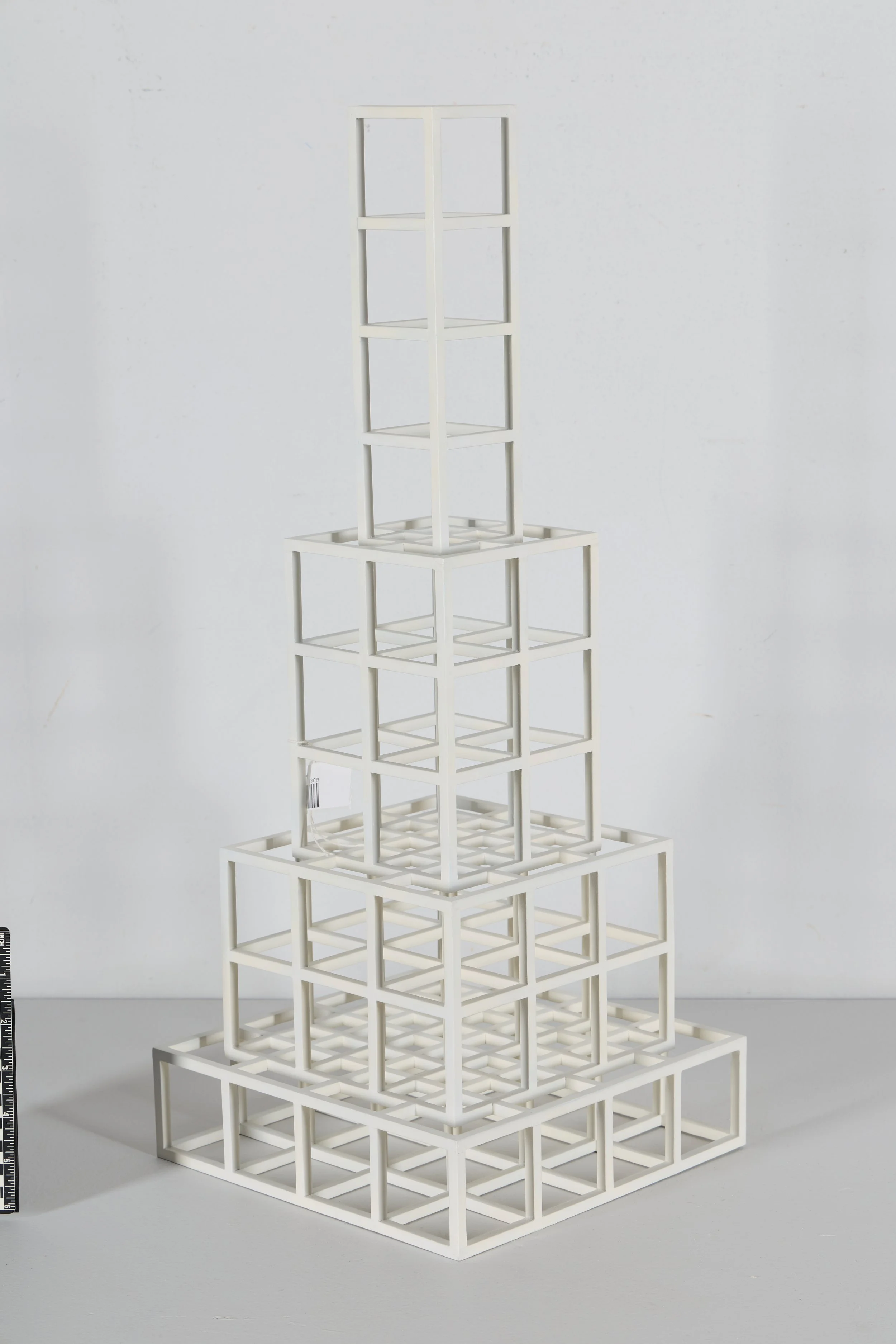
Cube and 4 x 4 x 1, two white enamel on aluminum sculptures by Sol LeWitt, recently underwent conservation treatment at The Center. Both works reflect LeWitt’s sustained use of modular form as a means of realizing a predetermined system in three dimensions.
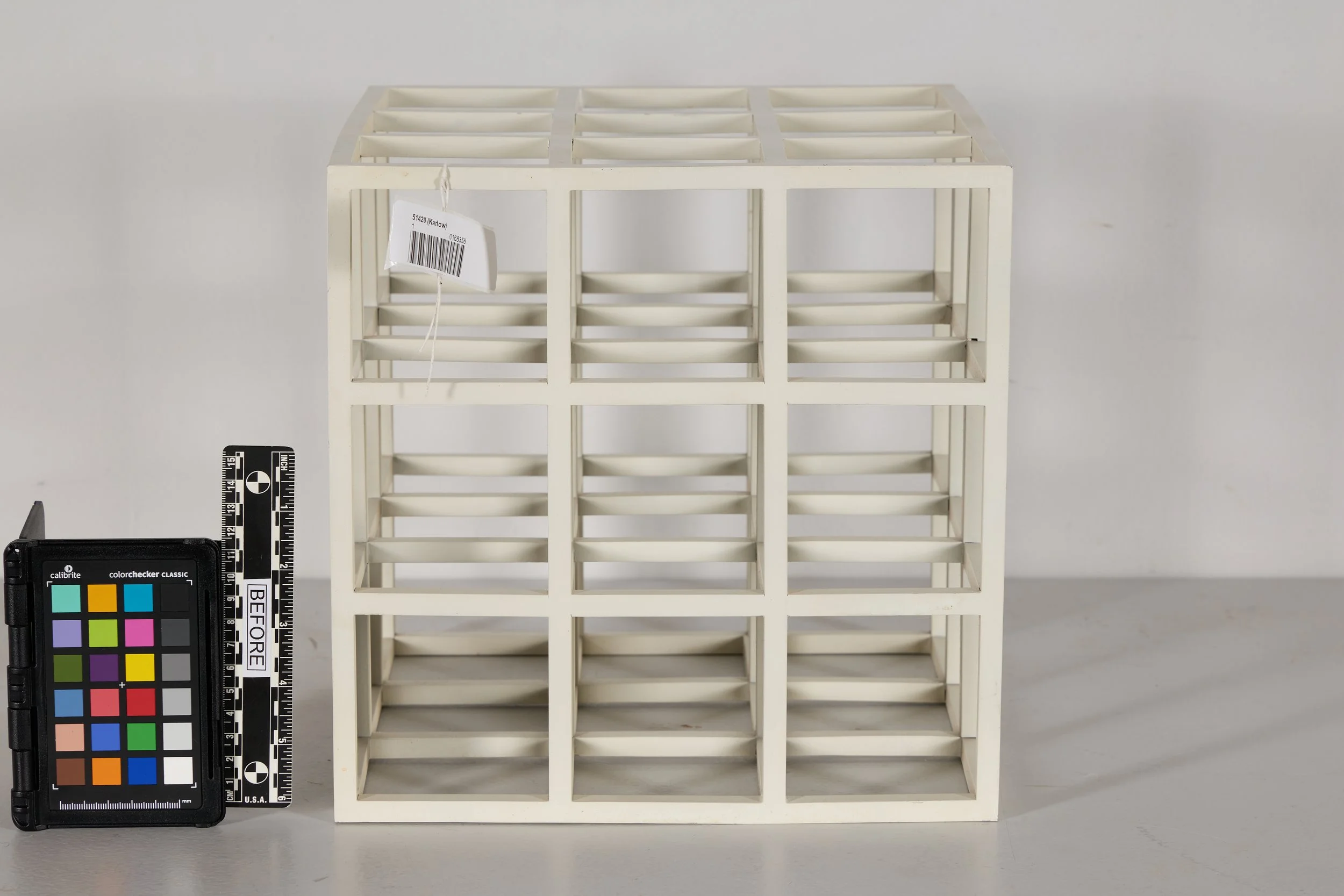
Before treatment.
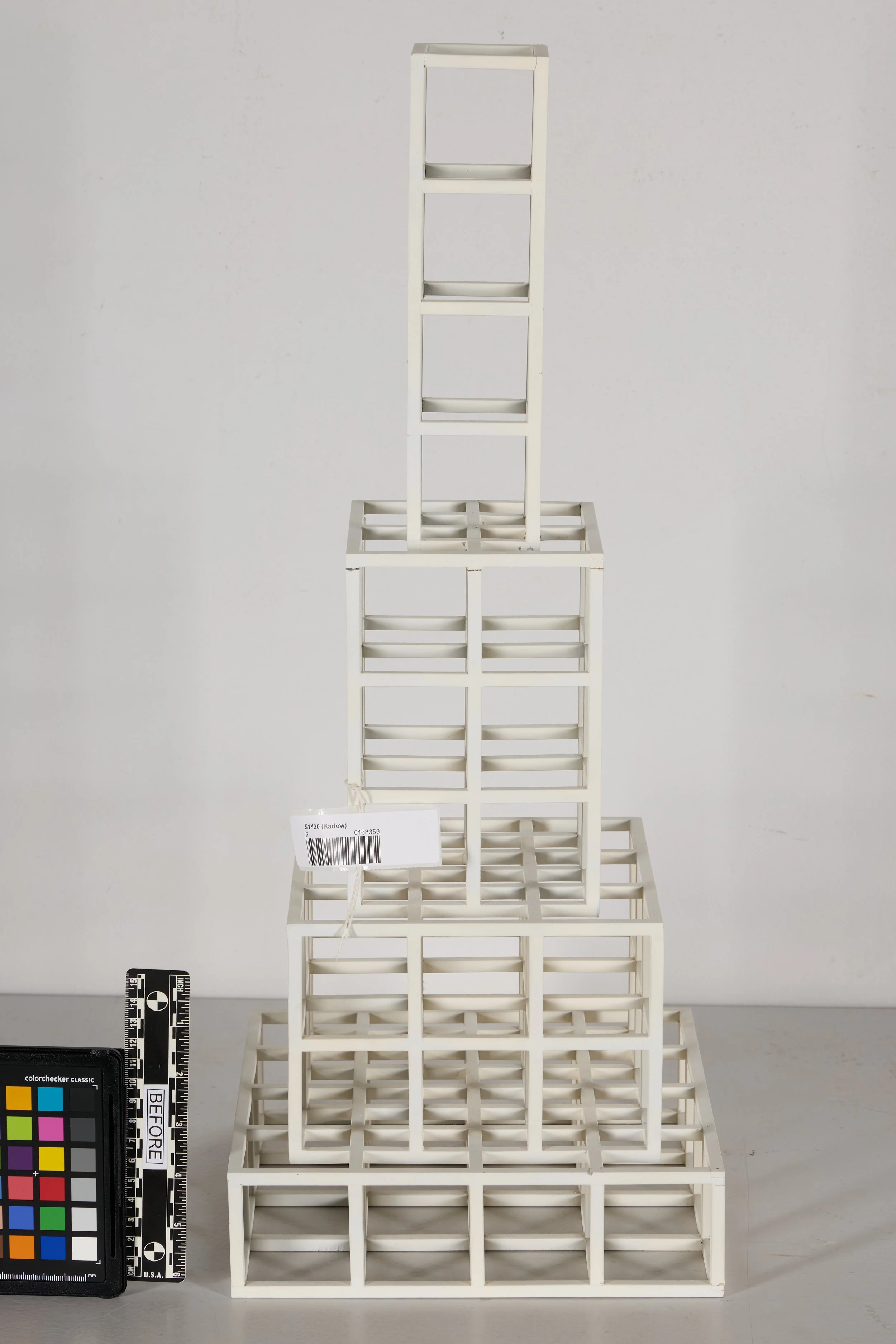
Before treatment.
LeWitt (American, 1928–2007) was a central figure in the emergence of Conceptual and Minimalist art in the late 1960s. In contrast to the subjectivity of Abstract Expressionism, he developed an approach grounded in predetermined systems, seriality, and basic geometric forms that could be visually compelling even when governed by strict or, at times, logically irrational parameters. Beginning in the early 1960s, he increasingly relied on modular structures, grids, and rule-based procedures to generate variation within narrowly defined limits. The cube became a recurring form through which LeWitt explored repetition, structure, and permutation across media. As noted in an exhibition catalogue essay, “Because of the possibilities for multiplication inherent in the grid form, a basic and seemingly unlimited vocabulary was at LeWitt's disposal... [the] serial form produced multipart pieces of finite order but infinite complexity.” (A. Legg, Sol LeWitt, exh. cat., Museum of Modern Art, New York, 1984, p. 9).
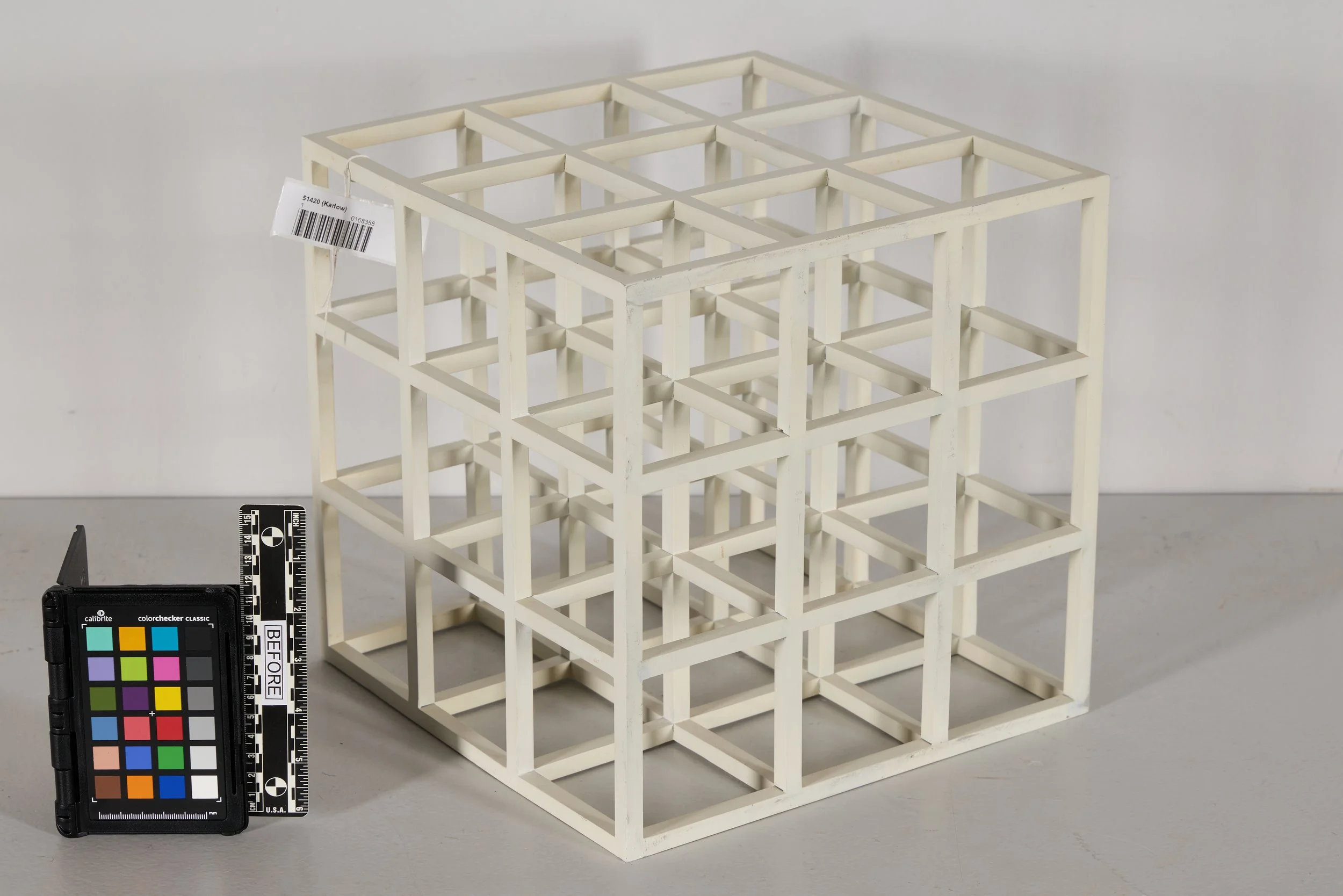
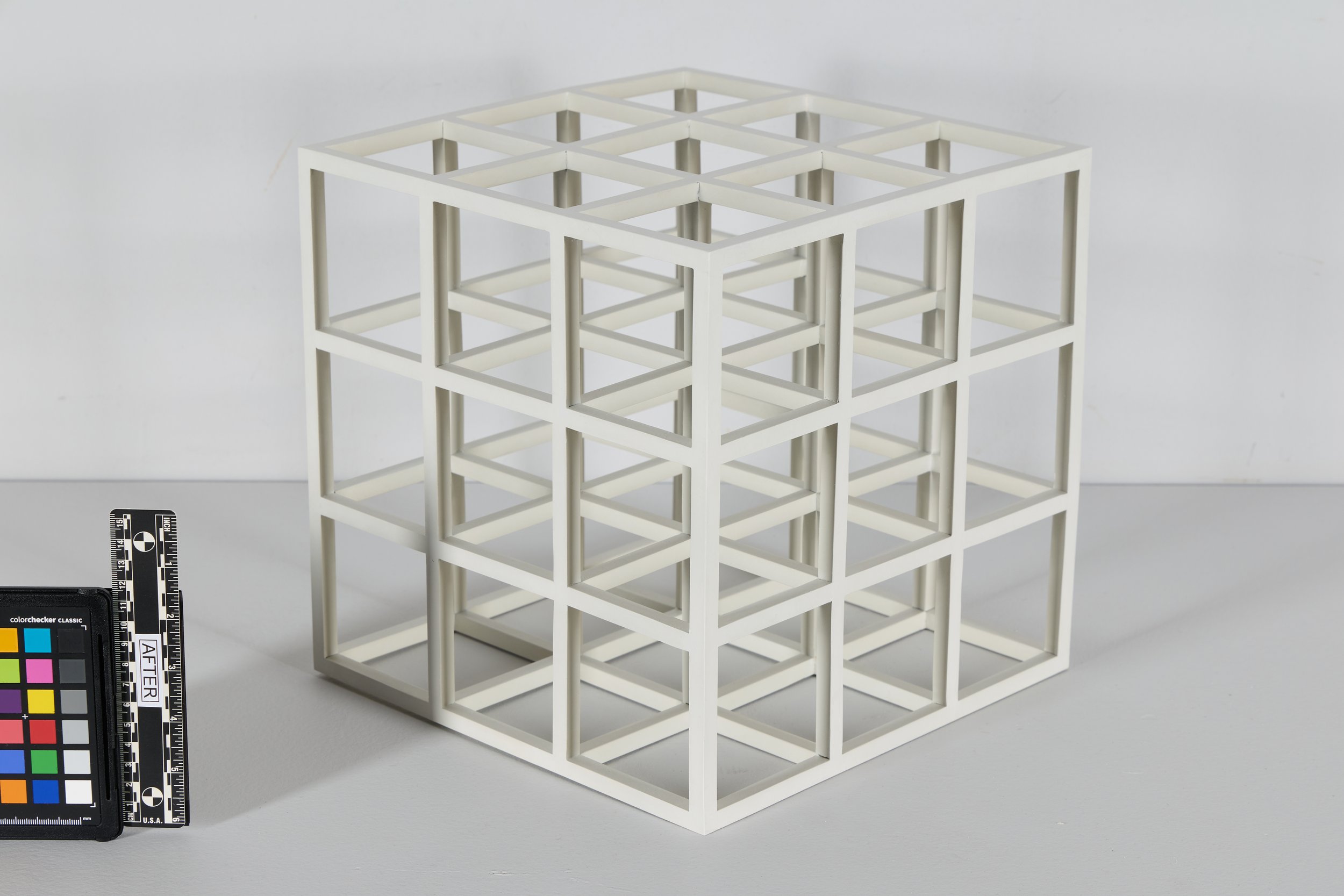
Cube, dated 1979 and signed on the base with a punched year and edition number, was constructed from square aluminum bar stock. The joints were welded and ground flat, and the surface was finished with white enamel paint. Subtle irregularities in the bars, including slight bowing and variations in thickness, were present and were understood as inherent to the fabrication process, particularly when compared with later, more mechanically precise examples from the series. Several joints displayed visible joint lines that had not been filled prior to painting, consistent with the original construction. While the structure remained stable overall, the surface exhibited heavy grime with minimal dust, scattered reddish-brown accretions, and black and grey accretions accompanied by scratches concentrated on one side, possibly the result of display in an unintended orientation. Minor paint losses and abrasions were present along the outer edges of the cube.
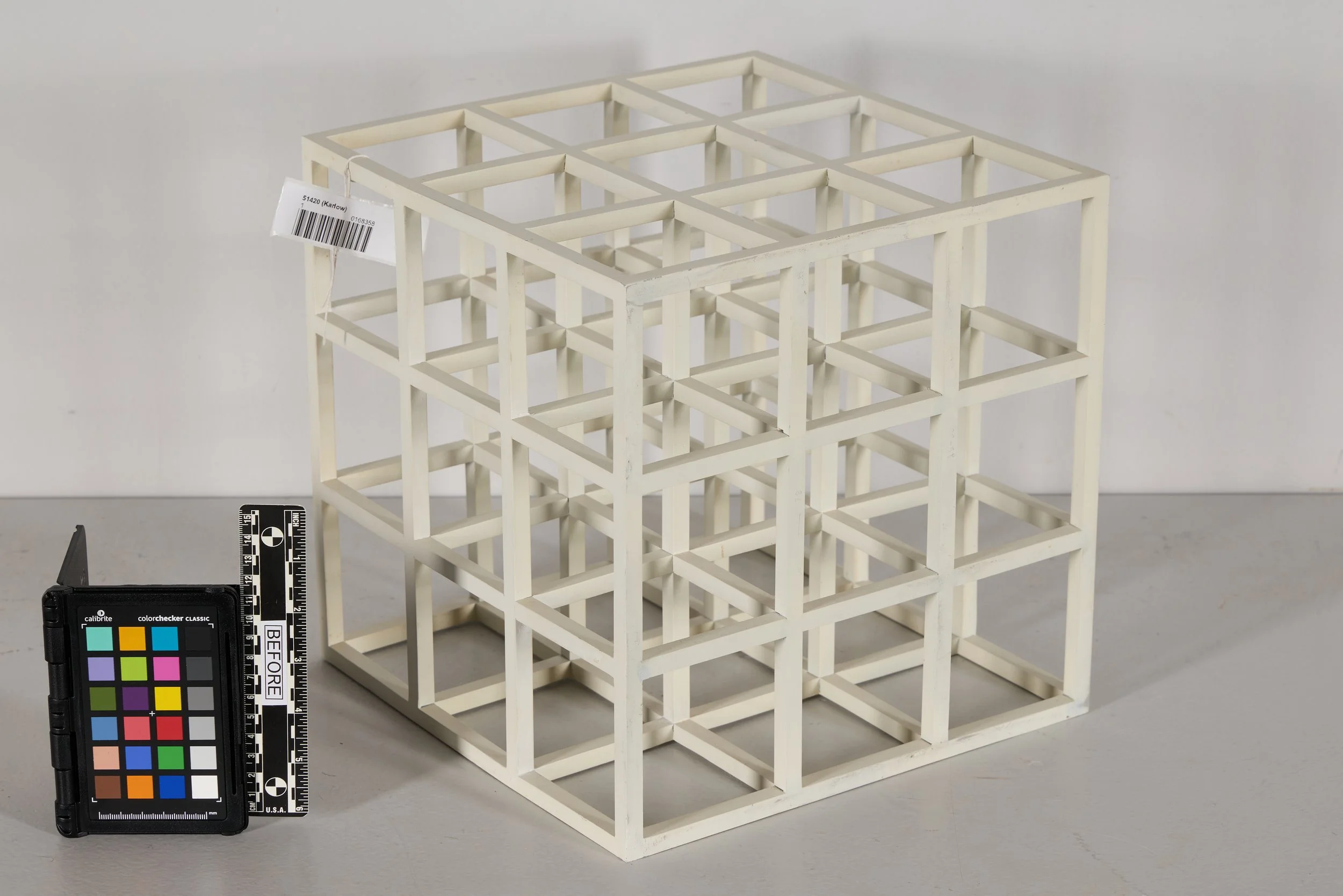
Before treatment.
The sculpture was photographed for in-house documentation before and after treatment. Surface cleaning was carried out on all sides using an aqueous solution to reduce accumulated dust and grime. Accretions and non-original paint restorations were removed using solvent systems selected to avoid disruption of the original enamel layer. Areas of paint loss were filled and inpainted using conservation acrylics and QoR watercolors, with careful attention paid to integrating the repairs with the surrounding surface while preserving the character of the original finish.
Watch a short video of our assistant objects conservator, Anastasiia Begunova, treating this sculpture — then scroll down to learn about the treatment of 4 x 4 x 1:
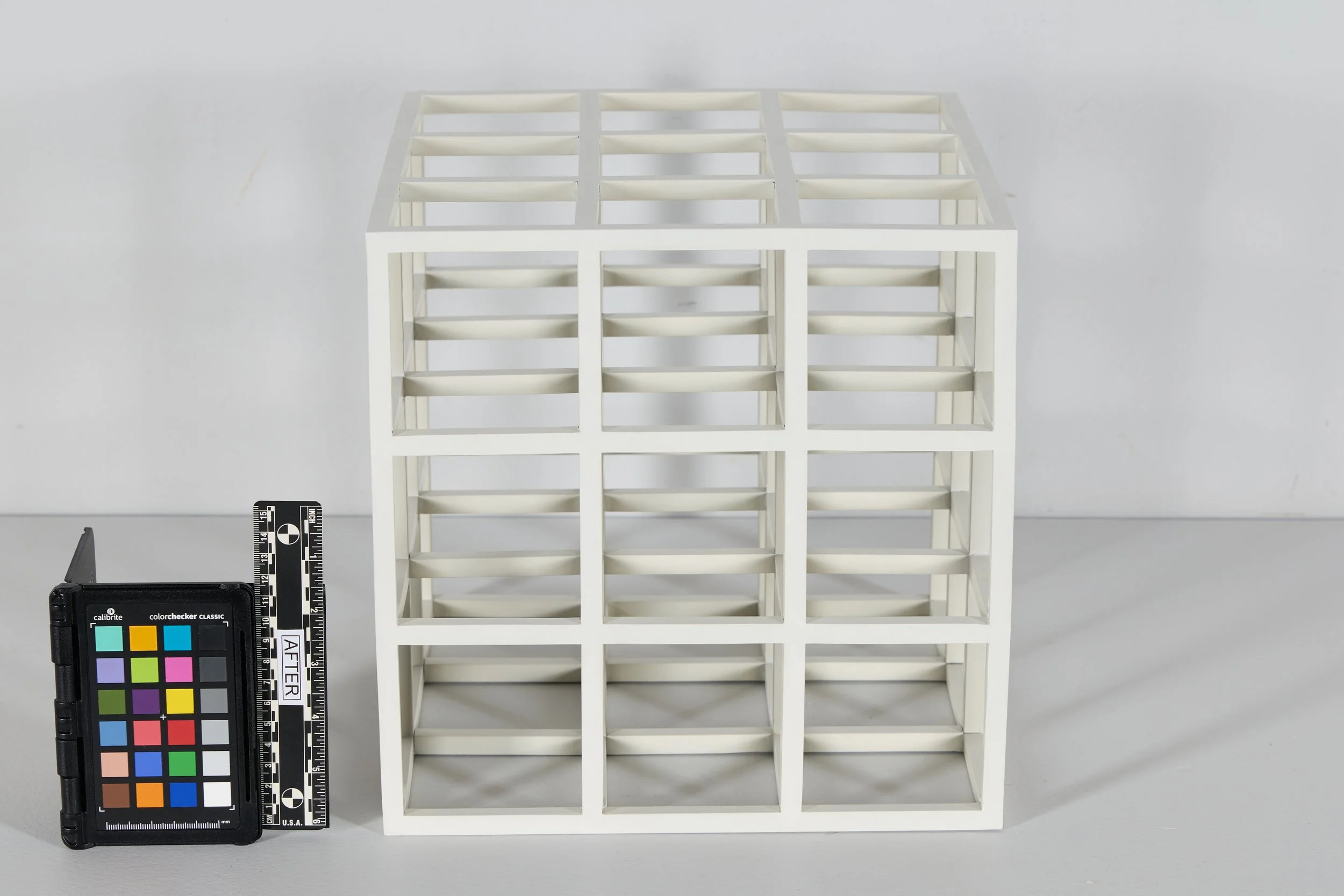
After treatment.
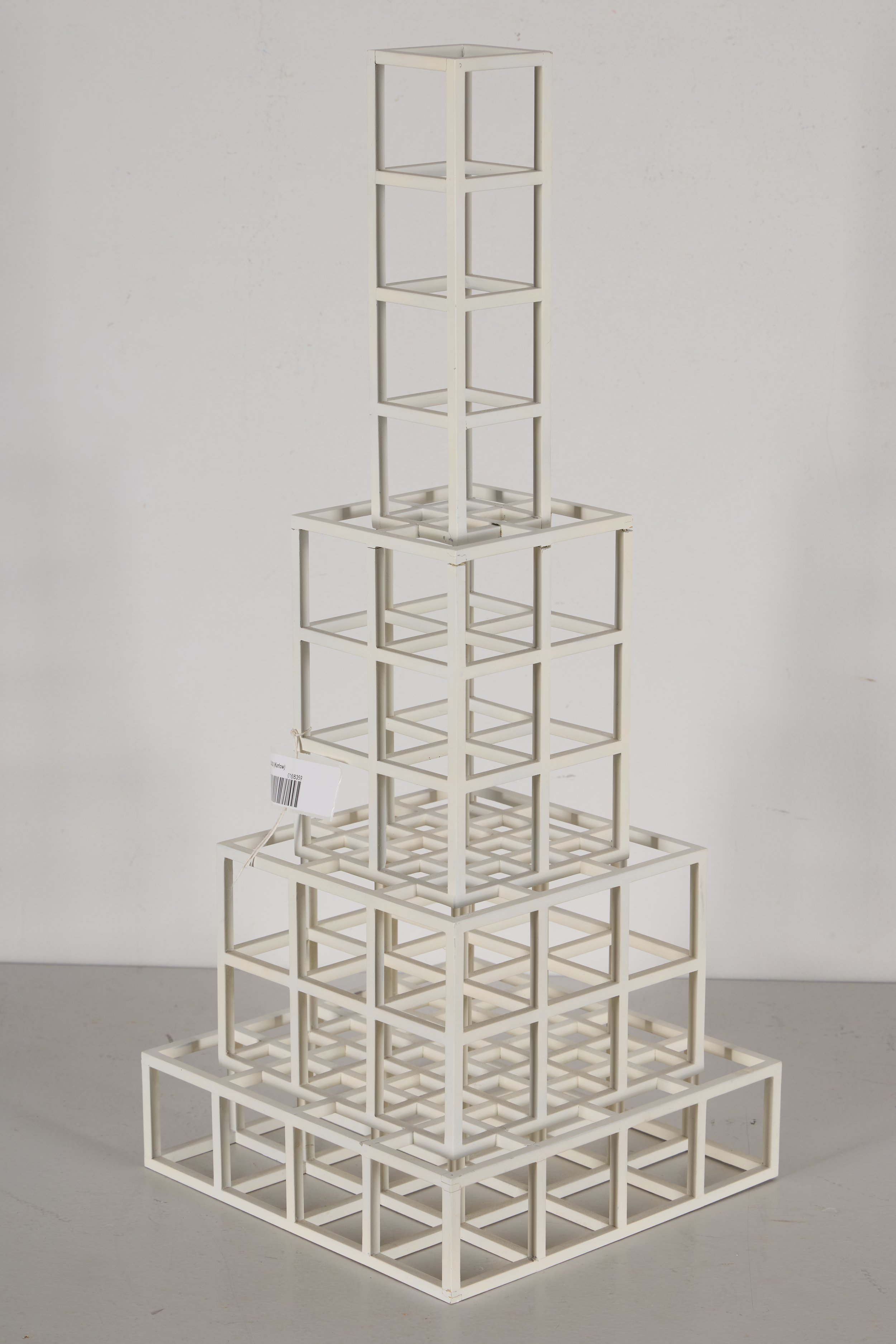
The second work, 4 x 4 x 1, was constructed from square aluminum bar stock assembled with metal pin joinery and spray-finished with white enamel paint. The sculpture consisted of four stacked rectangular tiers, each formed as a square grid, creating a vertical, tower-like structure. Condition issues varied across the tiers. In the upper tier, two joints were loose along one side, and multiple circular indentations from metal pins were visible at the outer edges of the vertical bars, some with associated paint loss. Cracking was present at nearly all joint lines, along with localized paint losses, black accretions, and surface grime. The second tier exhibited more pronounced structural instability, including complete separation at several joints connecting the upper grid, with gaps ranging from hairline fractures to approximately one-eighth of an inch. These separations were accompanied by cracking at lap joints, paint losses, brown accretions, and accumulated grime. The third tier showed more limited paint cracking and losses, minor abrasions at the outer corners, and evidence of a small prior paint repair. The bottom tier displayed moderate cracking at the joints, abrasions at exposed edges, black accretions, paint losses at pin locations, and several earlier restorations that were visually mismatched and excessively applied.
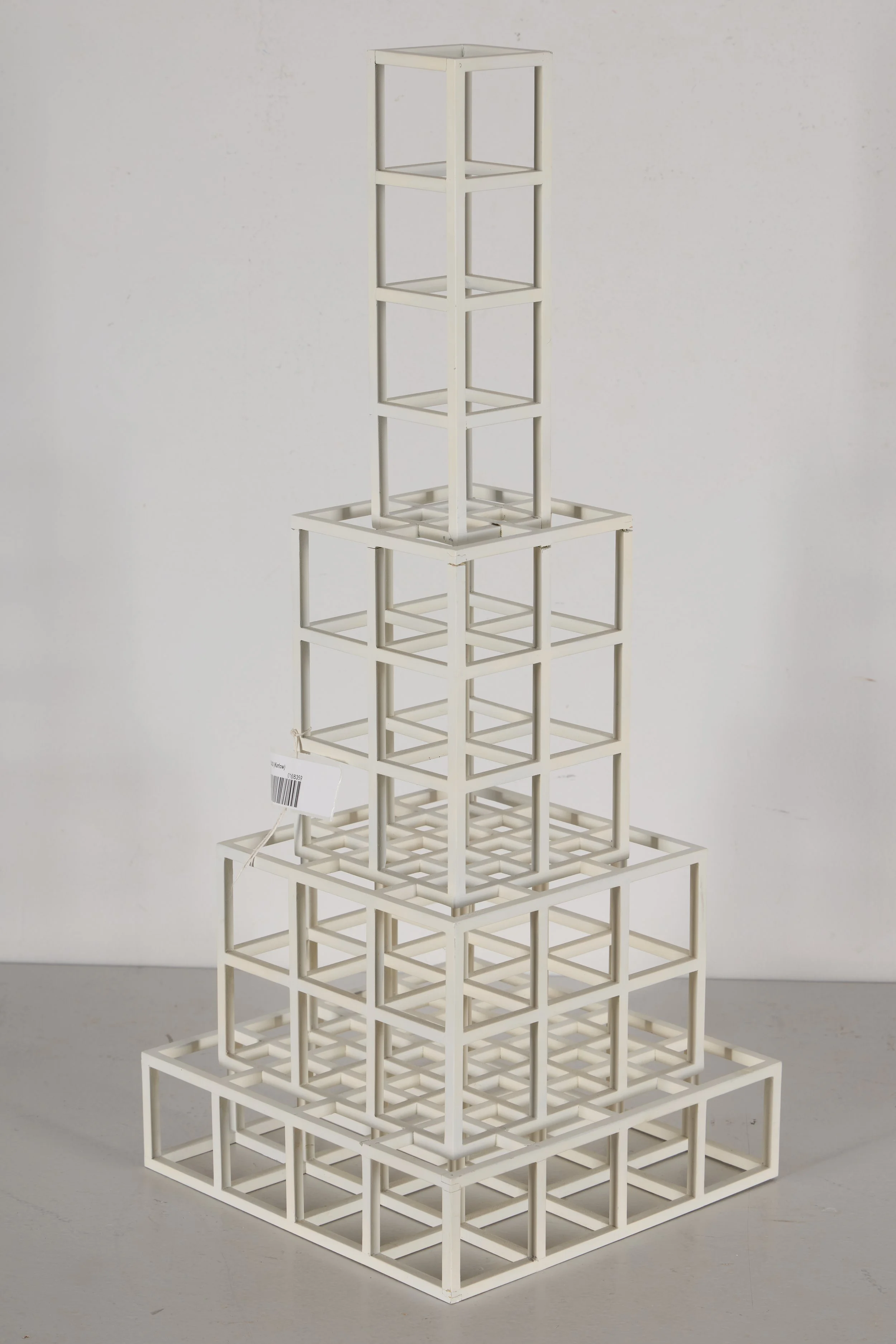
Before treatment.
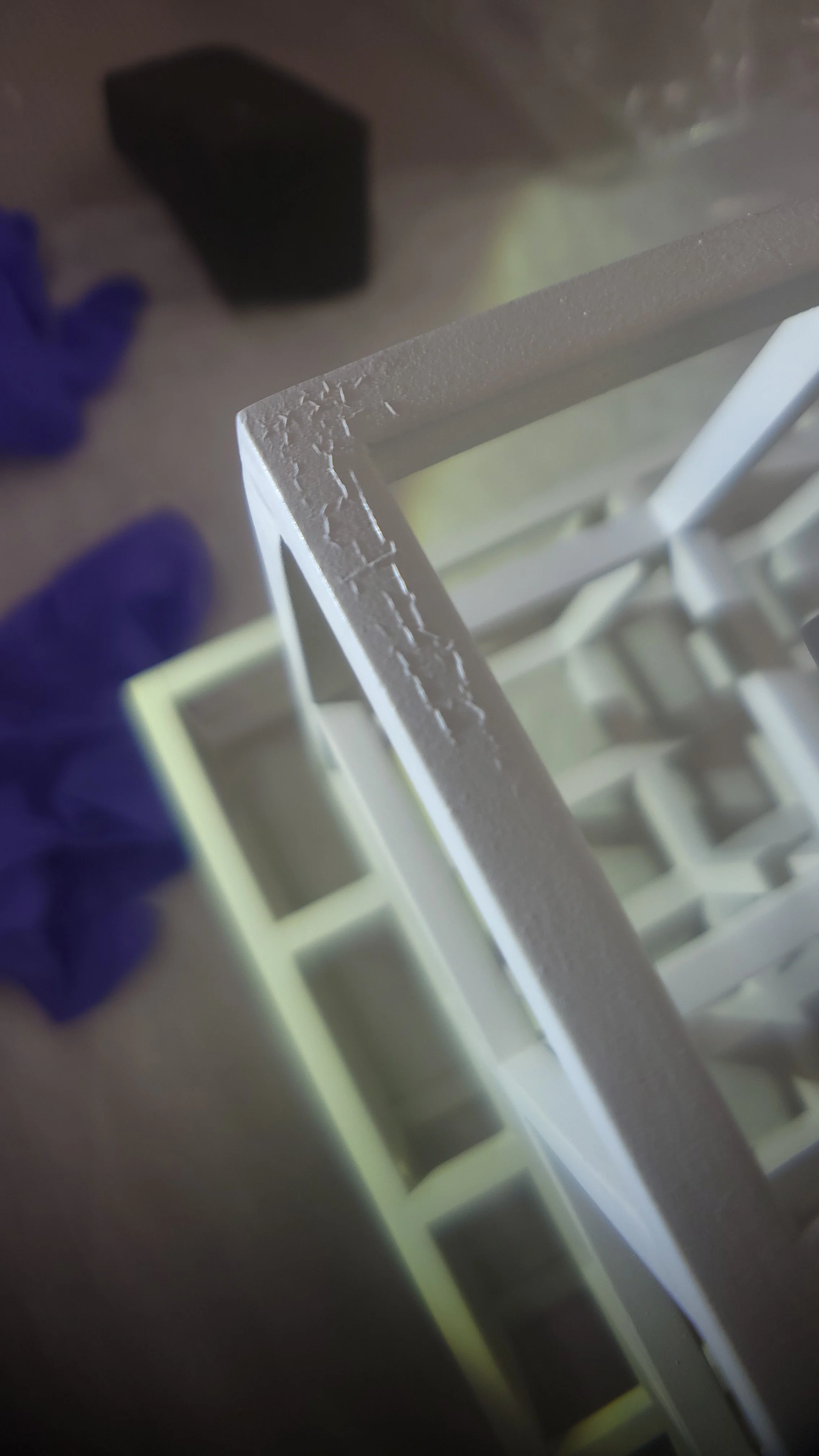
Detail of the cracking before treatment.
As with Cube, 4 x 4 x 1 was photographed before and after treatment. The surface was cleaned on all sides with an aqueous solution to reduce dust and grime. Accretions and non-original paint restorations, particularly those on the lower tier, were removed using carefully selected solvent solutions. Structural treatment focused on the second tier, where separated joints in the upper grid were realigned and secured using Paraloid B-48 modified with fumed silica. Areas of paint loss were consolidated with Lascaux 4176. Joint cracks and losses were then filled and inpainted using conservation acrylics and QoR watercolors to visually integrate the treated areas with the surrounding surface.
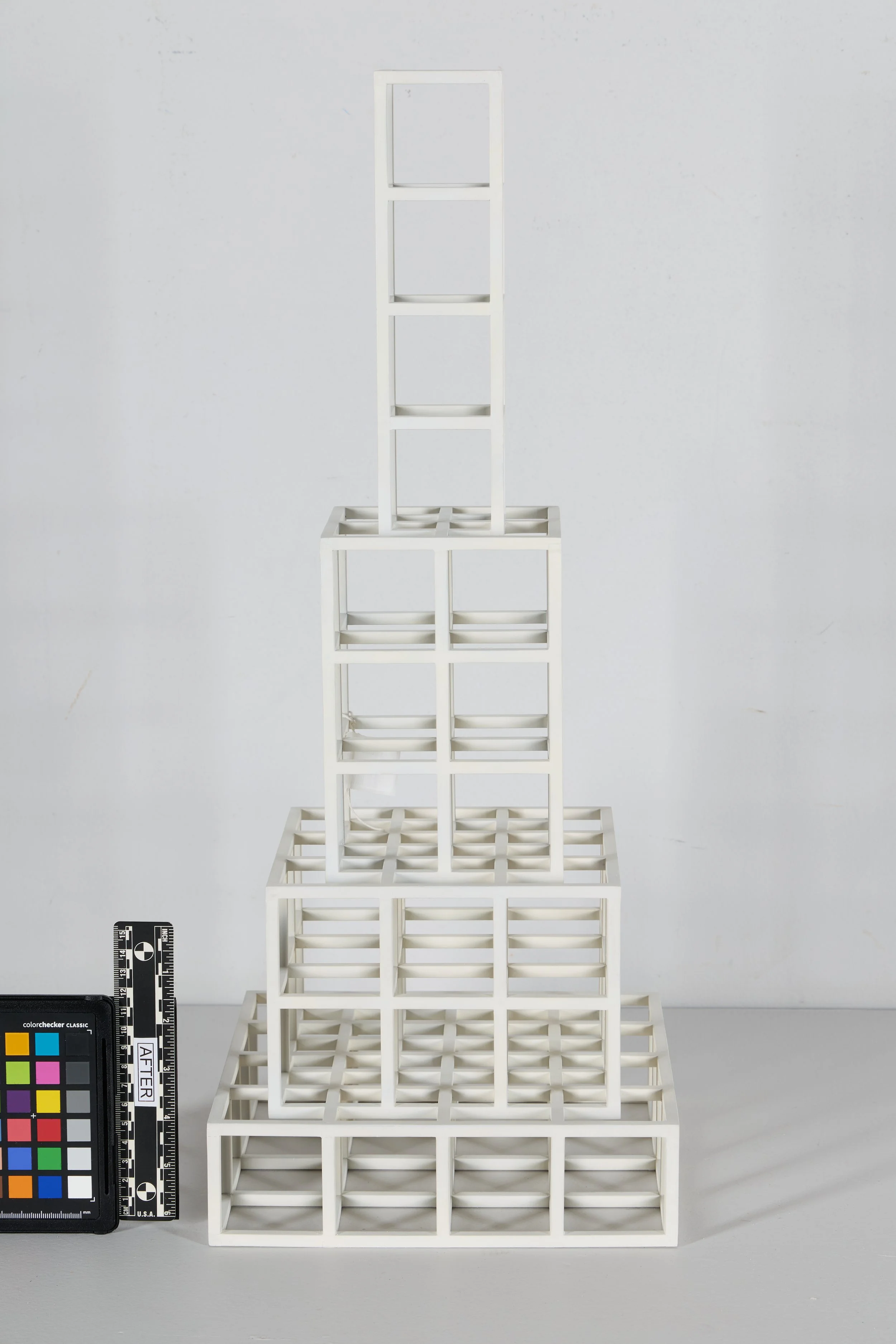
After treatment.
In works like Cube and 4 x 4 x 1, the simplicity of the forms draws attention to surface and structure. Conservation treatment was not intended to refine or correct the sculptures, but to stabilize their materials, address areas of damage, and restore overall visual coherence. This allows the works to be experienced as intended: precise realizations of systems shaped by repetition, variation, and structure.
Before treatment.
Before treatment.
After treatment.
After treatment.
Read about a previous LeWitt treatment here.
